

Emotional Intelligence: The Result of Healing Trauma
In leadership circles, emotional intelligence (EQ) is often hailed as the secret to success: the ability to regulate emotions, demonstrate empathy, and navigate complex interpersonal dynamics. But what if developing EQ isn’t just a professional edge—what if it’s actually a form of trauma healing?
Through the lens of trauma-informed work—especially models like the NeuroAffective Relational Model (NARM®)—emotional intelligence is the natural byproduct of healing developmental and relational trauma. It emerges when we no longer have to perform safety, but actually feel it in our nervous system.
The Hidden Origins of Emotional Reactivity
Many people assume that EQ is a skill you learn. But for those with unresolved childhood trauma, emotional regulation isn’t just about learning new behaviors. It’s about repairing early ruptures in safety, connection, and identity. Without this, even high-functioning adults may find themselves hijacked by old patterns—reactivity, people-pleasing, shutdown, or emotional detachment.
From Adaptation to Authenticity
NARM teaches us that many of our emotional patterns were originally adaptive. The child who suppressed anger became the adult who avoids conflict. The one who overachieved for approval became the perfectionistic professional. These survival strategies limit emotional range, distort relationships, and can be misread as emotional intelligence—when in fact, they are coping mechanisms.
True emotional intelligence arises when we relate to our emotions, not from them. This shift requires inner work that reaches below behavior change and into the roots of identity and safety. That’s where trauma healing comes in.
Why EQ Training Often Fails
Most EQ training in corporate or leadership spaces focuses on behavior: active listening, giving feedback, managing stress. These are useful tools, but they don’t address why we react the way we do. Without understanding the underlying trauma dynamics, we risk creating high-functioning personas that can mimic EQ, but aren’t sustainable or integrated.
What Trauma-Informed EQ Looks Like
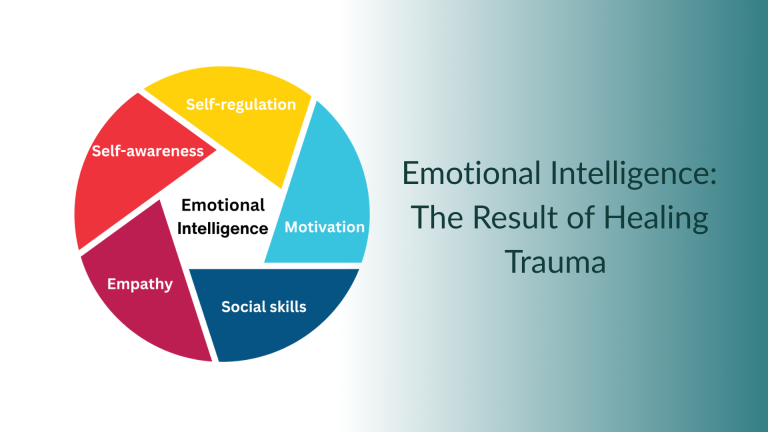
Self-Regulation is the Fruit of Healing : In NARM we address the root cause of the dysregulation rather than override it with breath work or some other practice . These root causes are the strategies we adopted to manage not having our needs met. The NARM process is designed to renegotiate these patterns and uncover our innate movement toward self-regulation.
Empathy Is Embodied: We have to be able to connect with our own experience (cognitive, emotional, somatic) in order to sense into the experience of others. Many of us had good reasons to disconnect from our experience as young ones. Reconnecting without overwhelming is the goal of NARM. A big part of accessing our innate empathy is the capacity for both self- and other-referencing simultaneously (most of us have a strong preference for one or the other). In NARM we call this the 50/50 of our attention. Even in a client session, I have half of my attention on myself and how the work and the client are impacting me. Caveat: In NARM we watch out for a tendency called “unmanaged empathy” which is about the need to save the client from their experience in order to avoid our own discomfort.
Self-Awareness: In order to tolerate seeing our self-destructive or -limiting patterns (and even our gifts) clearly, we have to be able to invite all of our parts back home and give them a seat at the table. There are many reasons this can feel like very risky territory. Those of us who have experienced developmental trauma may find it very difficult to embrace the disowned parts/traits/emotions as shunning them was related to our survival.
Social Skills: Social skills can be learned and practiced if we have developed the capacities for self-regulation, self-awareness and empathy. In fact, they arise naturally when these obstacles are removed. The biggest gap in social skills I see is the need for clear and authentic boundaries. Hint: this has to do with experiencing and integrating our anger/protest.
Motivation: In NARM we call this self-activation and it is a natural impulse that arises from deep connection to what we want and the self-confidence to move toward it. We often mistake real motivation for the drive to avoid shame or judgement or the drive to accumulate status or power so we feel less vulnerable. These are driven by fears related to our early relationships and have little to do with being connected to our deepest desires.
For Leaders, This Is the Edge
High-achieving professionals often reach a point where skills are no longer enough. Their leadership ceiling is set not by what they know, but by how they relate—to themselves, to others, and to discomfort. Trauma-informed emotional intelligence is the edge they didn’t know they were missing.
Healing Isn’t Extra. It’s Foundational.
The real secret of EQ isn’t in mastering techniques. It’s in becoming someone who can stay present in the face of emotion—their own and others’. That capacity is hard-won, and it doesn’t come from a training.
Ready to Integrate Emotional Intelligence from the Inside Out?
NARM coaching supports you to move beyond strategies into presence, resilience, and authentic connection. I’d love to have a conversation and discover how NARM Coaching can help you lead with self-regulation, clarity, compassion, and integrity.
SHARE THIS PAGE…