

Somatic Experiencing, SE®
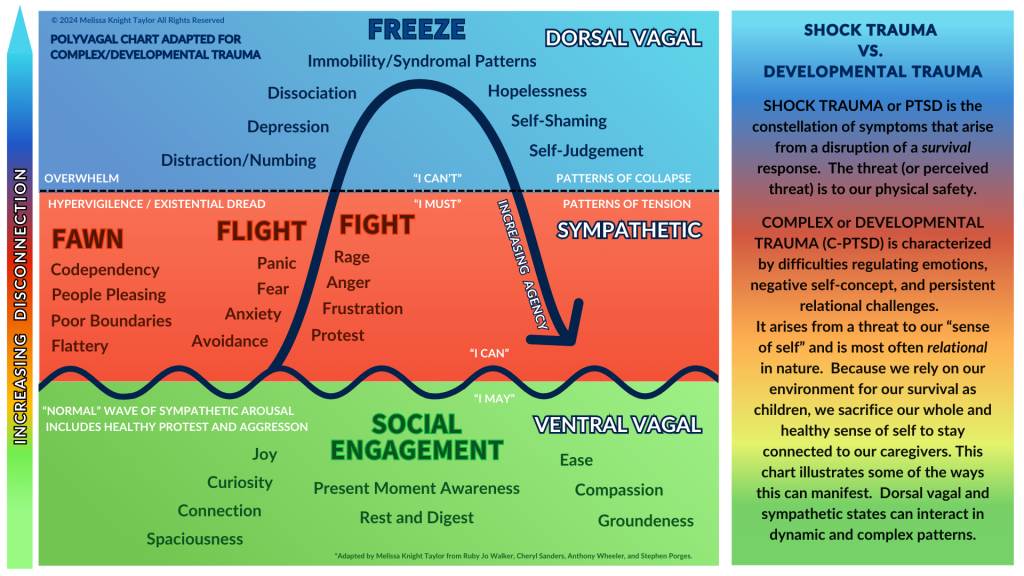
NOTE: If you are looking for Somatic Experiencing sessions, Schedule a Consultation Call to learn more. SE® works best for working with shock trauma or PTSD. It may not be suited for those of us who have experienced complex/developmental trauma. To learn about the difference between shock trauma and developmental trauma plus a detailed explanation of the chart above, check out What is TRAUMA? The NeuroAffective Relational Model (NARM) was designed to address the impacts of complex/developmental trauma, click here to lear more about it.
Somatic Experiencing® is a body based method of renegotiating shock trauma. Shock trauma (also known as Post-traumatic Stress Disorder or PTSD) is what happens for some people after an experience that is perceived as life-threatening or inescapable. This can be a singular event or multiple experiences that call up the same response. In the moment of a traumatic event, innate survival responses are invoked, more or less automatically. When these physiological movement/impulse patterns are not completed (there are many reasons why this may happen), there are lingering physical and psychological symptoms that can ensue. Sometimes we may not even remember or realize the impact of the originating trauma.
This powerful method, informed by Stephen Porges’ Polyvagal Theory, aids in supporting the re-regulation of the nervous system through uncoupling the conditions that were present at the originating trauma. In SE, we break these conditions into five categories represented by the acronym SIBAM:
S – Sensation
I- Imagery
B – Behavior
A – Affect
M- Meaning
When we survive something that is (or perceived as) life-threatening, these conditions can become over-coupled. When any one of them are present, the system invokes the survival response that was used in the originating trauma because it worked. This can be very confusing as the trigger may be below the threshold of awareness. So we may start to (consciously or unconsciously) feel anxious and avoid situations where one of those conditions might be present.
When the nervous system is able to fully complete the survival response (usually accompanied with some form of energy discharge), we can stop being hypervigilant about those conditions and relax into the ventral vagal state. This most unguarded state is also know as “rest and digest,” or “the social engagement system.”
As the title of Bessel van der Kolk’s book states, the body really does keep the score. It is truly wondrous to witness the body complete these survival patterns and have greater capacity for the wide range of experiences that make up a human life.
Somatic Experiencing® International offers an in depth description of the methodology and the science behind the process. You can find that here.
SHARE THIS PAGE…