

NARM Adaptive Survival Styles
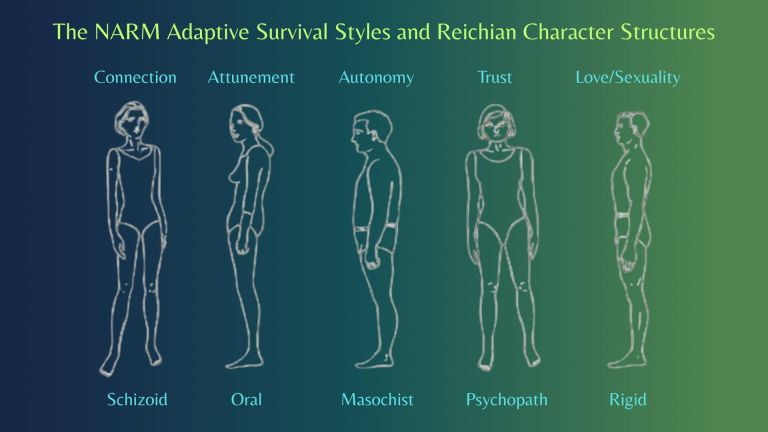
The Adaptive Survival Styles were adapted from Wilhelm Reich’s (and later Alexander Lowen’s) character structures. As you can see in the image above, the names for the character structures depict them as pathological. In NARM, these patterns are (more gently) named for the unmet needs from childhood that give rise to each style. This allows for the reality that we all use survival strategies in some form or another.
Our physiological, psychological, and emotional capacities develop in phases throughout childhood and adolescence. When the needs/project of a phase is not met, these capacities are compromised. The Adaptive Survival Styles are clusters of strategies we develop as adaptations to these environmental failures. The environment includes first, the womb, then the body we are born into, our relationship with attachment figures, the home situation, community and even geopolitical contexts.
There is great variance in the severity of the disruption such that two people using the same style could have VERY different degrees of disorganization and capacity for connection. When there is early relational trauma, the success of the next phase is threatened, and so on throughout development. So, sometimes people identify strongly with one or two of these styles, and others see themselves in all of them.
I will give an overview here and, in future posts, elaborate on each one.
Connection Survival Style
The Connection Survival Style represents a disruption at the very earliest stage of development (in utero through the first few months of life). This very first phase sets the scene for all future development. It’s as if the child never fully landed in the body or were never properly welcomed. This experience is also referred to as the “unwanted” or “hated” child. All forms of connection to self and others feel threatening and may be experienced as a nameless dread. Freeze, dissociation, and fragmentation are characteristic of this style. There are two subtypes, intellectualizing and spiritualizing.
Attunement Survival Style
The disruption for the Attunement Survival style occurs between 6 months and 2 years. This can result from prolonged separation from the mother, a mother with her own developmental trauma, divorce or other household disturbance, the child’s serious or chronic health problems, and chronic misattunement to the child’s need. The little one manages these situations by disconnecting from their own needs. The adult using this adaptation will have difficulty feeing and expressing their own needs, challenges managing intense emotions, and be preoccupied with fear of attachment loss. They may fear and reject “neediness” and project their own needs on to others or have unrealistic expectations for their adult relationships. The subtypes are inhibited and unsatisfied.
Trust Survival Style
The Trust Survival Style develops from 1.5- 4 years old. Vulnerability and dependence on caregivers was not safe and even used against the child. This can span a continuum from very subtle manipulation (using the child to illicit a response in the other parent) to profound abuse and chaos in the family. As adults, this pattern uses power, control, aggression, and bodily armoring to keep themselves impervious to others and stay on top. On the more disorganized side of this style, someone may create an elaborate and deceptive persona that is precisely the opposite what is happening internally (reaction formation) in order to manufacture a response from others. The two subtypes are seductive and overpowering.
The Autonomy Survival Style
The Autonomy Survival Style also develops from 1.5 years to 4 years old under different circumstances and dynamics than the previous style. Autonomy, or increasing age appropriate self-determination, is not supported and even punished by caregivers. Highly anxious parents, or parents who view their children as extensions of themselves may be very controlling during this period. The child feels bound to choose between their authenticity and being in connection. As adults, this style feels paralyzed by self-doubt and inner conflict. They put enormous amounts of pressure on themselves for everything. They often place others in a role of authority to which they either must comply or defy, leaving them with no good choices. The subtypes are rebellious and submissive.
The Love/Sexuality Survival Style
The Love/Sexuality Survival Style develops in two separate phases, 4-6 years and 12-15. People who use this style may be highly successful and attractive. It can develop when parents reject emerging sexual curiosity and expression, or when love is conditional on performance and appearance. As adults, this pattern relies on external cues to guide them and may have a very distorted view of themselves. They have difficulty experiencing both love and sexuality simultaneously. There is an emphasis on doing to avoid their inner experience and vulnerability. Perfectionism and the “right” way reign, deferring to rules or established norms. The subtypes for this style are romantic and sexual.
Sound Familiar?
Do you see yourself in any of these Survival Styles? How about your loved ones? While there is nothing more compelling than a personality typing system, I invite you to use these with care and for the purpose of self-understanding. NARM therapy interventions vary significantly and are guided by the particulars of the survival styles. If you’re interested in working on any of these dynamics in your life, let’s chat.
SHARE THIS PAGE..